
Coliving, Digital Nomadism, and Remote Work: Why shouldn't a coliving be just a coworking with beds?

The classic dream of remote work was sold to the world through a very specific and almost cinematic image. It was always an open laptop facing the sea, bare feet in the sand, a tropical drink in hand, and the smile of someone who had supposedly hacked the traditional work system. But if you have been practicing digital nomadism for long enough, you know that this iconic scene was never more than a well-produced photo for social media. The reality of remote work on the beach involves screen glare that makes reading impossible, a complete lack of power outlets, missing Wi-Fi signals, sand ruining your computer keyboard, and unbearable back pain due to a total lack of ergonomics. There is no possibility whatsoever for that to be a sustainable professional routine.
The profile of the remote professional has matured deeply in recent years. The search today is no longer for the most exotic backdrop to take a photo, but rather for the most intelligent and welcoming structure possible. We want to travel, see the world, and explore new cultures, but we need to work to pay the bills. It is exactly in this maturing scenario that the concept of shared housing gains strength in Brazil and around the world. The home office on the road needs to be productive.
However, as the demand for flexibility grows and the sharing economy expands, a very clear problem emerges in the market. The corporate real estate sector began to homogenize the experience. Many enormous buildings, eager to attract this new audience, started calling themselves a coliving space, when in absolute truth they are nothing more than a lifeless model.
In this article, we will delve into the various layers of the digital nomad's real life, explore the roots of this housing movement, and understand once and for all why choosing a coliving focused on genuine community building completely transforms your relationship with your work, with the new city you have chosen to explore, and with your own daily routine.
1. The Evolution of the Digital Nomad and the End of the Beach Photo
Digital nomadism has definitively ceased to be an exclusive movement of young recent graduates backpacking without a set destination and on very tight budgets. Today, a large portion of global remote workers are professionals in their thirties or older. We are talking about experienced developers, designers, project managers, art directors, psychologists who offer online sessions, entrepreneurs, and leaders who carry heavy responsibilities on their shoulders.
For this mature audience, constant unpredictability goes from being a fascinating adventure to an exhausting risk. Today's digital nomad needs consistency in their delivery. They do not give up geographical freedom, but they demand in return quality internet, a comfortable chair, an environment to focus on difficult tasks, and good coffee available. Their temporary office needs to have a very high level of comfort and efficiency. This is why the traditional tourist accommodation model often fails to meet the real needs of those who must hit targets and deliver results at the end of the month.
2. The Isolation Hangover and the Silent Reality of Remote Work
Right at the beginning of the journey for those who adopt remote work as a lifestyle, renting a temporary apartment through an app seems like the translation of ultimate freedom. You pick a new neighborhood, pack your bags, and move. But the continuous practice of this process reveals a very complex side that very few influencers discuss on the internet, which is the deep isolation hangover.
Spending weeks or even months in a closed apartment, working completely alone, creates an invisible bubble around you. The routine becomes cold and highly mechanical. You wake up in the morning, make coffee in your own kitchen, sit in front of the computer, attend virtual meetings all day, order delivery for dinner, and go to sleep. The emotional and logistical effort required to build genuine connections in a new city consumes a lot of energy. Generally, when you finally start to understand the dynamics of that neighborhood and make your first local acquaintances, your rental period ends, and it is already time to leave for the next destination.
This repetitive cycle of loneliness is one of the biggest causes of fatigue in the life of a digital nomad. This is exactly where coliving steps in as a natural answer to loneliness.
Coliving allows that, on the exact day you unpack your bags in a new city, you already have a group of interesting people with whom you can share a glass of wine in the backyard or debate an idea in the kitchen.
3. The Roots of the Movement: From Cohousing to the Sharing Economy
To understand the depth and seriousness of a coliving space, we need to go back in time a bit and look at history correctly. Many people believe that intentional communal living is a recent fad, but the root of what we experience today was born in Denmark. In the late 1960s and early 1970s, Danish families idealized the concept of cohousing. The architect Jan Gudmand-Høyer and other pioneers realized that the isolation of traditional houses no longer made sense. These families kept their private areas, but they created large common spaces to cook, care for children, and interact daily. The main focus was never just reducing financial expenses, but rather the human and ancestral desire to belong to a group, to have a support network, and to share life intentionally.
As the decades passed, technology advanced, and the sharing economy revolutionized our relationship with material goods and physical spaces. We realized that we did not need to own everything. We started sharing cars, tools, and bicycles. In the professional world, this revolution gave rise to coworking, a model that allowed independent workers and companies to share office infrastructure. Modern coliving is, therefore, the historical fusion of this Danish desire to live in community with the practical intelligence of today's sharing economy, all tailored to the reality of digital nomadism.
4. The "Coworking with Beds" Trap
As we mentioned earlier, coworking was one of the most useful expressions of the collaborative economy in the business world. It holds great value for those who need a commercial address or a dynamic place to work and hold meetings. However, when observing the growing demand for flexible housing and remote work, there was an attempt to replicate the coworking model in housing in an extremely commercial way. This is how the term we use comically and ironically in the title of this text was born, the cold coworking with beds.
These spaces are, in essence, gigantic corporate buildings. The experience is completely sterile. You rent a standardized studio, take the elevator down with your headphones on, sit at a massive shared table on the ground floor, and often spend days without exchanging a genuine good morning with the person sitting next to you. Is it practical from a real estate perspective? Perhaps it is for some people. But it is empty of connection.
A coworking space is incredible for its commercial purpose, but a coliving space focused on a true human experience cannot simply be a coworking space where you sleep. If the essence of the place is not the pulsating desire to live in community, it is merely traditional lodging disguised with modern vocabulary.
5. What Really Defines a Community-Focused Coliving?
We know that the housing market is vast, and you can find precious information about the most varied types of coliving by reading our guides on the Horizonte Blog. But when we talk about a coliving strictly focused on community building, we are talking about architectural and cultural intention.
Living in a coliving with this soul means that the place was designed to generate casual encounters. It is the difference between having a small isolated kitchen in your room so you do not have to leave it, and having a well-equipped kitchen where different accents naturally cross paths when preparing breakfast. It is a physical space where respect for individuality and your moment of silence is sacred, but where the doors are always open for those who wish to belong to something bigger than their own travel itinerary. We focus on building a community because we understand that people are looking for real bonds and not just furnished square meters.
6. Our Process: Eye to Eye and the Right to Feel at Home
This is one of the most fundamental pillars of Horizonte Coliving, and perhaps the point that best ensures the quality of our experience. For a community to thrive and be a healthy environment for your remote work and rest, the house must, above all else, be a safe haven. It is an extremely bad feeling to arrive at an accommodation and not feel completely relaxed, or to end up locking yourself in your own room out of fear of the external environment. You need to feel at home.
For this reason, the formation of our community involves very human care. We do not just have a cold digital form where a person simply checks off coexistence rules. We make a point of getting to know people. We schedule a video call or an in-person visit with absolutely everyone who wants to live with us. We speak frankly, we are transparent about the daily routine of the house, and we openly ask if that person truly wants this lifestyle.
It is a crucial moment to ensure that anyone who comes to live here understands the beauty and responsibility of communal living. People need to know how to respect collective spaces and be aware that a coliving is a place for social exchange. More importantly, it is a space of non-negotiable respect for differences. Regardless of the religion, gender identity, sexual orientation, or cultural background of whoever arrives, this person must find a safe environment. Our processes guarantee that you will share the house with people who have also gone through this same frank conversation and who, just like you, are willing to respect and welcome others.
7. The Invisible Infrastructure that Supports Your Home Office
It is pointless to have a vibrant house, inhabited by incredible people and with deep conversations late into the night, if the next day you cannot open your spreadsheet or present your results because the house's infrastructure failed. For the digital nomad and the home office professional, work is the engine that makes this entire charming lifestyle possible.
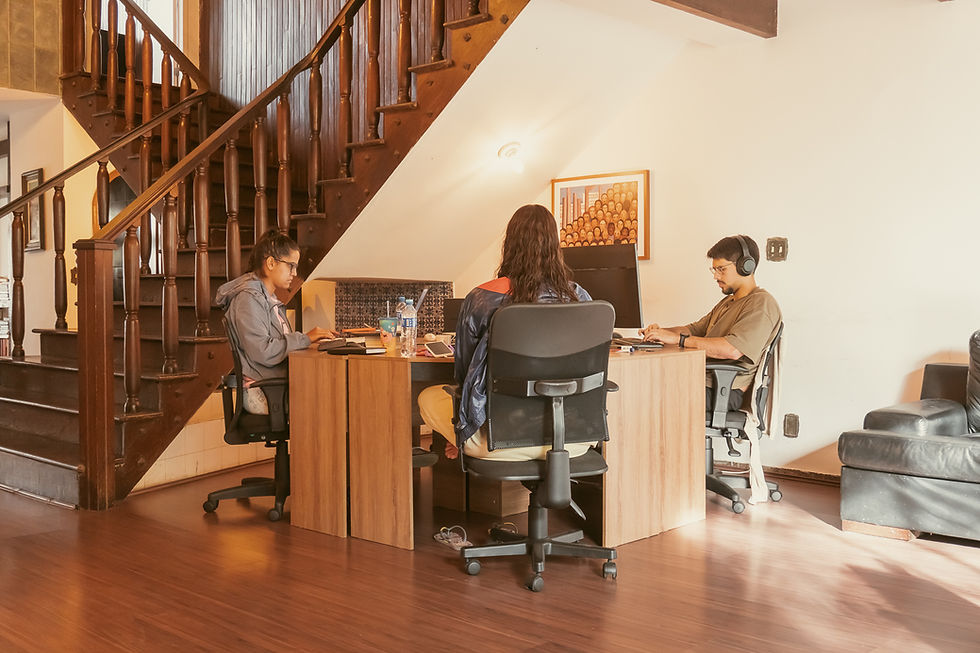
Therefore, in a well-structured coliving, the infrastructure aimed at productivity is taken seriously. This means offering comfortable workspaces, a quality Wi-Fi connection, suitable furniture, and a workplace where it is possible to concentrate. You do not have to improvise at the edge of the dining table while someone bangs pots and pans next to you. Remote work reaches its peak when the environment flows so well that the infrastructure allows you to focus solely on what you do best.
8. Organic Networking Versus the Forced Networking of the Corporate World
Anyone who attends traditional events or works in a purely commercial coworking space knows that strange feeling of forced networking very well. It is that mechanical moment where people exchange business cards in a rehearsed manner, usually with a purely unilateral interest and thinking only about what the other can offer as an advantage for their own career.
The daily dynamic inside a coliving space subverts this logic. Networking becomes an organic and human process. The best business partnerships, the most accurate hires, the most valuable advice, and the richest intellectual exchanges happen very spontaneously, while two people share the stove to prepare lunch or wait for the coffee to brew. In coliving, you first get to know the human being, their stories, and their values, only to later discover the professional's potential. This creates true bonds of trust that the traditional corporate market can rarely replicate.

9. Healthy Boundaries and the Separation of Spaces in Remote Work
One of the biggest challenges for those who live working from home is that, when your office is just a few inches from your bed, your brain loses its natural ability to identify the exact time to switch off. The boundary separating well-deserved rest from professional obligation disappears, and it is not uncommon to see digital nomads working exhausted through the night because they cannot leave the focus environment.
Living in a coliving helps professionals reestablish these physical divisions that are important for a healthier routine. Because the structure offers specific coworking areas and dedicated workspaces, you can create a practical daily ritual. You wake up, have your coffee, and go to the work environment, even while being inside your own house. At the end of your shift, the physical act of closing the laptop, getting up from the office chair, and walking towards the balcony or garden signals to your mind that the day of effort is over. Having this clear division between the place of concentration and the place of socialization is fundamental to maintaining lightness in your routine.
10. Authentic Local Immersion: Stopping Being a Tourist to Truly Live the City
The modern traveler and the contemporary digital nomad are tired of standardized tourist itineraries packed with cliches. When you arrive in a new city to spend a season working remotely, your main goal is not just to take quick photos in front of famous monuments, but to experience the city as if you were part of it.
By choosing a coliving focused on the community experience, you skip that lengthy adaptation phase. The house acts as a welcoming bridge to the local culture. If you choose to live with us in one of our colivings in Belo Horizonte, for example, you will have access to a very rich universe through the people who already know the city deeply. Through this daily coexistence, you will discover the charms of walking calmly through the Mangabeiras neighborhood, participate in the fantastic cultural life on the streets of the Santa Tereza neighborhood, taste the spectacular food of local pubs that are not always in travel guides, and delight in the gentle chat and the unforgettable mineiro accent that permeates the conversations in our backyards. You stop being a tourist spectator and become part of the city.
11. The Smart Math of the Collaborative Economy
Beyond all the social, cultural, and safety benefits we have covered throughout this text, it is also part of our mineiro way of being to keep our feet on the ground and speak honestly about financial planning. We know perfectly well that the choice of housing is highly personal. If your dream is to buy your own home and tend to your own garden, or to rent an apartment to live alone, these are also wonderful choices. There is not just one right way to live life.
But for those looking to combine coliving, digital nomadism, and remote work with quality of life, or for those who have just arrived in a new city, the math needs to make sense. When you grab a calculator and add up the costs of a vacation rental, a monthly subscription to a quality coworking space, separate electricity, water, and internet bills, plus cleaning and maintenance costs, you quickly realize that the cost of a solitary itinerant life can be quite high.
The coliving model solves this issue through the sharing economy. As we detailed in our article about how much it costs to live in a coliving space in Brazil, the model centralizes all these complex expenses into a single, predictable monthly fee. For those who want to focus on remote work and exchanging experiences without wasting time managing household bills, living in a coliving is undoubtedly very smart math.
12. Coliving as the Ultimate Base for Remote Work and Digital Nomadism
The revolution of digital nomadism and remote work has already happened all over the world. Technology has already proven to the market that we can deliver excellent results working from anywhere. Our challenge now is no longer looking for a Wi-Fi signal, but rather protecting and cultivating our human connection, our well-being, and our temporary roots.
A coliving space that breathes community is proof that you do not have to give up your professional life to have a rich social life full of good stories. You do not need to tolerate small, cold, and lonely studios, or conform to the idea that living on the road necessarily means being alone. If your home office routine allows you the wonder of choosing your own destination, your housing should allow you to live your present time with safety, respect, and joy.
At Horizonte Coliving, we carry the essence of mineira hospitality, and we understand the dynamics and dreams of those who work online. We create spaces in Belo Horizonte thoughtfully designed so that your work has the structure and respect to flow, and your routine has the human warmth you deserve to feel embraced in our community. Because at the end of the day, the most sustainable and happy way to travel the world working remotely is to have the absolute certainty that, upon opening the front door, you are home.


Comments