
Accidental Nomad: What 3 years on the road taught me about digital nomadism.

Almost every digital nomad starts their story by saying they always dreamed of exploring the world. Not me. I loved the city I was in, and if the world hadn't turned upside down due to Covid, I might never have stepped out of that comfort. The truth is, the opportunity for remote work, combined with sheer exhaustion over how the country was managed during the pandemic, were the driving factors that led me to adopt digital nomadism.
My name is Yuri, I am an economist, a former traveler, and also one of the creators of Horizonte Coliving, here in Belo Horizonte. My journey up to the founding of the coliving was shaped by chance, shifts in direction, and itineraries created for reasons sometimes meaningful, sometimes trivial.
If you are also looking to take this step, here is the real account of how I transformed a temporary escape into a lifestyle, along with a few tips on how not to go broke in the process.
Pré-nomadismo digital
It all started during the pandemic. I was living in Minas Gerais, a land that embraced me culturally and became my home, but the uncertainty of that period led me back to my home state to be close to my family. I needed to feel safer amidst that chaos. I went back with the intention of spending just a few months, and the stay ended up stretching into a year.
As the months went by, the desire to go far away grew as that political instability gained more strength. Meanwhile, I was waiting out the three-month gap between the first and the second dose of the vaccine. It was then that I decided to start moving, albeit in a timid way. I went to explore the coast of Ceará, hopping from beach to beach, isolating myself for a month in each place. There, working remotely and close to the sea, I started to genuinely take an interest in that lifestyle on the move.
It was around this time that I started consuming more content about digital nomadism. I listened to Nati Dalpiaz's podcast from Psico Prô Mundo, the place where I go to therapy to this day. In one of the episodes, she interviewed Leandro Mariani, and I immediately bought his course on living while traveling.
Leandro explained that it was necessary to escape traditional conversions, the high IOF taxes, and the abusive banking spreads of Brazilian banks. It made perfect sense, after all, I would easily save 5% to 10% of the money spent abroad. My economist mind synthesized the first lesson clearly: those who convert, keep the fun going longer. The only people who do not convert are those who return home after two weeks or those who earn in a strong currency. For those who earn in reais and want to stay on the road, financial planning is vital. Otherwise, the experience ends early, and it is time to return with a maxed-out credit card.

He also taught a golden logistical rule: always buy only a one-way ticket, go from point A to B, then to C. Buying a round-trip ticket doubled the cost and restricted the itinerary. Here happened the first clash between the tourist I was and the traveler I was to become. I heard all of this, thought it was brilliant, and what did I do? I bought a round-trip ticket to Chile. The tourist won because my idea was not to adopt the nomadic lifestyle. I just wanted to spend two months outside of Brazil and return home.
The math of long-term stays
Two months went by in Chile, and the idea of going back felt wrong. I remembered the lessons from the course, tore up the original plan, and changed my ticket. The victory of the second clash belonged to the traveler forming inside me, and I left for Argentina with only a one-way ticket.
Even so, my plan was to stay just one month in Buenos Aires, and then the adventure would finally be over. For an ordinary tourist, a month is an eternity. For a nomad, it is the beginning of stability. And it was there that I understood one of the main factors that helped me sustain this lifestyle for three years: the economics of long-term stays.
Many people think traveling is expensive because they calculate the cost based on hotel daily rates or short-term stays on Airbnb. The problem is the high turnover. When you book four weeks or more on reservation platforms, it is common to get discounts that slash prices by 30% to 50%. I realized that spending a whole month in the same place is not only culturally richer, it is financially smart.
The math is simple: will the trip be more expensive than the fixed rent of an annual contract? Probably, but it is considerably cheaper than paying for 30 individual hotel nights. And if you have an empty house sitting back in Brazil while you travel, you will spend double. Giving up the house or renting it out temporarily will help cover a large part of your stay.
Understanding this transformed my "one month in Buenos Aires" into eight months in Argentina. I stayed three months in Buenos Aires, spent a few weeks in Uruguay, and returned to Buenos Aires for one more month. With my cost of living already under control, I was able to move on to a new destination in Argentina that sparked a lot of curiosity in me.
Freedom to put down roots
Driven purely by my love for wine, I thought: "I am going to Mendoza". I went there to stay for a month. I stayed for three.
It was in this city, which was not yet a heavily explored route by Brazilians, that I unlocked my Spanish and saw snow for the first time. Mendoza was the city where I was most able to experience local life, and that only happened because I decided to skip other destinations that every traveler told me I should visit. There, life truly happened. Right in my first week, I was welcomed by a group that had come from Buenos Aires. We met on a Free Walking Tour. By the way, it is a great way to make new friends, besides allowing you to explore a new city from an excellent perspective: getting to know it on foot.

I arrived in Mendoza the same week as that group. They went there to complete part of their medical residency at a local hospital, while I went there to drink wine. Through them, I was able to truly understand and participate in Argentine culture. I was included in almost everything they did: regional food nights, poetry readings at home, get-togethers at friends' houses, trips to bars, parties, and visits to wineries off the beaten path. It was because of these friendships and this immersive experience that I decided just one month was not enough. I figured I would stay for two months and then spend a month in Salta. However, I soon realized that wouldn't be enough either. I decided to stay for three months, the exact same period they would be in Mendoza. In that city, I made real friendships, the kind you remember for a lifetime and that deserve to be nurtured. When I finally left Argentina, they were the ones who took me to the airport. Whenever we miss each other, we call out of nowhere just to see how life is going.
That is the beauty of traveling without a rush: you allow people to change your schedule. If I had a rigid five-day itinerary, or even a strictly planned month, I would never have experienced any of this. On the other hand, I also learned that to enjoy freedom in a healthy way, I needed a few anchors. Keeping up with my online therapy was one of them. Traveling alone can be scary, yes. It brings loneliness. And knowing how to ask for help or having a professional to talk to helps keep your mind grounded.
The need to return
I was ready to keep moving up the map. I was thinking about going to Salta, and I came very close to buying tickets to Peru. The inertia of the movement was carrying me forward, but a piece of news made me drop every plan: Milton Nascimento was announcing his final concert. At the Mineirão stadium.

For me, Clube da Esquina is not just an album. It is a pillar of my life. Back in college, I lived in a shared student house named after the record. That musical movement represents friendship, the act of coming together, everything I valued the most. I canceled the trip to Peru, bought the concert ticket, and booked my return. I went back to Brazil and spent two intense months in Rio de Janeiro that changed my perception of the city. I am certain that one day I will open a coliving space in Rio.
I finally made it to BH. Reuniting with my home and my friends was a profound shock of belonging. I had not felt that much "at home" in Ceará, or in Mendoza, or anywhere else for that matter. Coming back was not a failure, it was part of the journey.
Sabbatical year and community life

Before arriving in Minas, I had experienced an anxiety crisis that led me to think I needed to change my career path. I was not happy professionally, and after some time in BH, I decided to resign. I wanted to create something new, connected to culture, but I still did not know what.
During the previous months, I had understood that one of the main virtues of traveling alone was its potential to catalyze processes of self-knowledge. Thus, I got to know myself better. Having myself as my sole company was no longer so uncomfortable. I would go out to dinner alone and think about life. Here, once again, I had a different story from most nomads, who usually say that traveling makes them completely different people. I, on the other hand, became more and more myself. So, to understand what I was actually looking for, I knew I needed to lose myself even more to finally find myself.
With the savings I made in Argentina due to the devalued currency, I set off for a sabbatical year in Europe. It was 10 countries and 3 volunteering experiences.
In Germany, I lived the peak of the community experience. I worked for a month at Sommerwerft, a theater festival that welcomed 100,000 people. As if that was not already an incredible experience for someone who worked in finance, I also had the opportunity to live where the theater company members and their families lived. It was an area away from the center of Frankfurt, looking like an industrial zone. There they lived in a community, with over 30 people spread across small houses and caravans. If all that was not enough, during the festival, over 300 volunteers came to help set it up, and 100 of them lived together with the theater company. I was one of them.

I had never seen such great diversity. There were people from 20 different nationalities, all living in shipping containers, tents, and even in those yellow school buses. Any space in that industrial area was adapted to host the volunteers. It was intense, I felt 15 years younger, everything felt new, and emotions were running high. It was an eye-opener, I wanted to live in a community. Maybe not with 100 people all at once, but perhaps 10.
Soon after, during a volunteering stint in England, while talking to the people working with me, it clicked even more. They noticed that perhaps I loved that chaos of social interactions because I grew up in a full house, with my mother, my grandparents, my great-grandfather, aunts, a dog, a parakeet... all under the same roof. I grew up in a community. There I understood that my natural habitat was not the solitude of a small apartment. Traveling alone teaches you to be self-sufficient, we can go to the movies or have dinner alone, without feeling uncomfortable. However, living in a community teaches you to feel like a part of humanity.
From then on, I traveled through several coliving spaces, trying to learn from those who had created these places and understanding the real needs of those who lived in them. Before creating mine, still afraid of starting something that to this day almost no one knows what it is, I met the creator of Nine Coliving, in the Canary Islands. She invited me to apply for a European Union grant for entrepreneurs, making it possible to finance one or two semesters living, researching, and working with her. However, I was blocked by the bureaucracy that Latin Americans face around those parts, not because of her, by the way, I highly recommend Nine.
I returned to Brazil with a feeling of failure, which I thought I had already learned to deal with a year and a half prior. It seems I had not. But the fact is that the business plan was done. Months later, the lesson was finally learned, and Horizonte Coliving was open.
A traveler's advice
If you want to experience this, my advice is not "go scared, but go". My genuine advice is: go with intelligence, both rational and emotional. Use technology to your advantage so you do not lose money on banks, flights, or accommodation. I could recommend platforms, but I stopped traveling two years ago and everything changes. Just do some research and you will find them. This account focuses on the real lessons that the experience taught me. If you are looking for operational tutorials on travel platforms, the internet is full of technical guides. After all, to be a good traveler, you need to know how to research. Also, look for long-stay discounts, stay a month, breathe the city in, it is cheaper than rushing through it in a week. Use the various platforms available to find multicultural events, meet people, and escape unwanted loneliness.
And, above all, understand that traveling is about adapting, about letting the path flow, but also about recognizing when loneliness hits hard and you need people. Whether inside or outside Brazil, having a community is what makes us feel at home.
The Horizonte Coliving experience

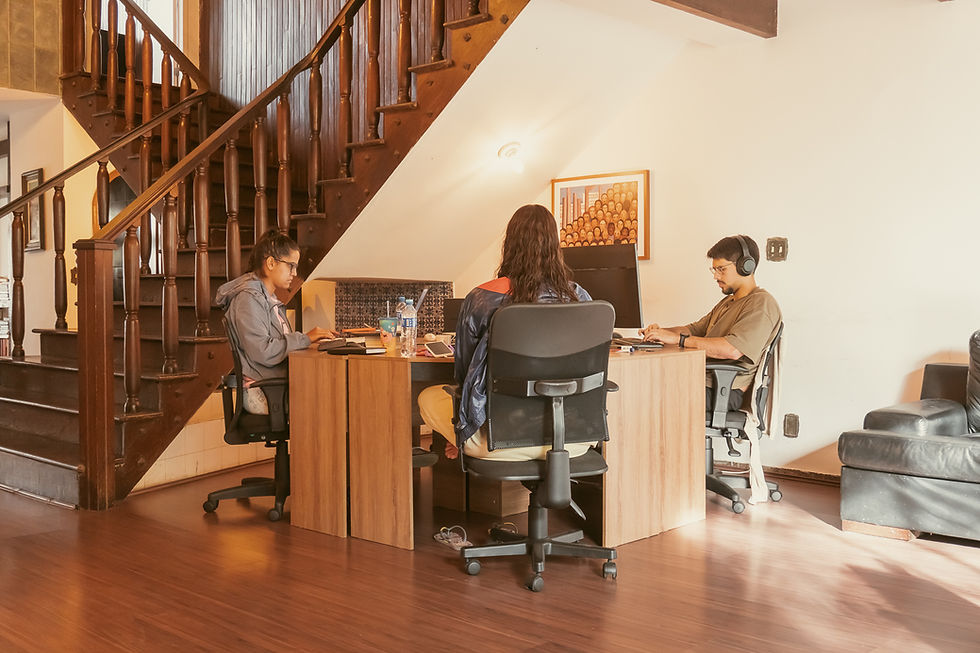
If you are looking for your next destination, or perhaps your first "point B" on this journey, Horizonte Coliving was created exactly to be that safe haven. Here, we take the art of welcoming seriously. It is the place to experience Mineiro culture at its core, where a "good morning" comes accompanied by a freshly brewed cafezinho and an unhurried chat. We want you to feel that rare feeling of knowing, right in the first few days, that you have come home. The road may be long, but the arrival has to be sweet. Come have a cafezinho with us, I will let you ring the bell.


Comments